Bok Friday
"Wimpie, whose finger nails are caked in grease after a week's worth of fondling the inside bits of engines, shoots for his fifth brandy and coke. Nie brandewyn of Wimpie het nie brieke nie."

Hi there! Welcome to The Crow’s Nest, a monthly newsletter documenting a South African debut author’s traditional publishing journey. If you’re new here, thank you for subscribing. I hope you stay a while.
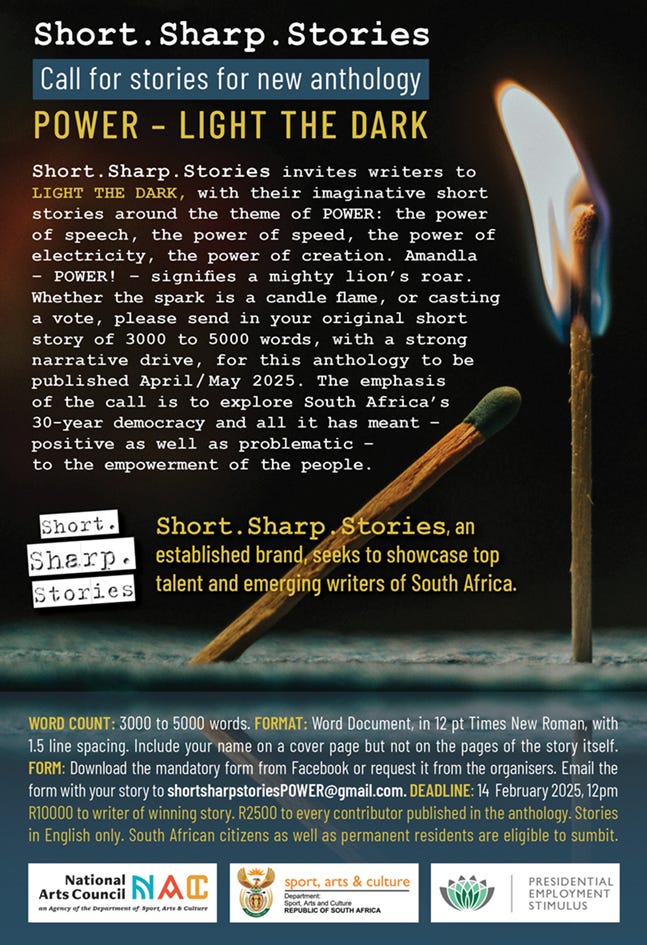
About a year ago, I wrote a short story for the Short.Sharp.Stories anthology. My “gotcha day” for my debut novel, Bloodbird, was acquired by Mirari Press during the same time. I was convinced that MP would come back with a nay and the panel of SSS with a resounding yay. The theme was POWER, and boy, I thought I’d nailed it. I’m not sad to announce that I was wrong. The exact opposite happened. I didn’t quite know it back then - my most beloved grandmother had passed away only two days before I received the best news of my life from the fabulous Marius du Plessis - but the universe was conspiring to give back to me in abundance.
The call for submissions poster
Background
Bok Friday is a work of autofiction - one part true; three parts made up. The idea came to me when I recalled a story my mom had told me when I was young, about the attempted abduction of my grandmother to be sold to a Sangoma. And while I know many Wimpie archetypes, I know them by other names. Speaking of names, I’ve changed that of the narrator’s.
Bok Friday
My maternal great-grandmother lived on rural land somewhere in the old Transvaal, during a time when the unofficial de facto flag, The Red Ensign, aspired to thwart the Boer Republic’s enthusiasm for freedom. This piece of cloth did not represent her ancestors, who’d made the journey from Europe to Africa in 1652 as employees of the Dutch East India Company. And certainly not those, who’d left the Cape Colony in 1883, to escape England’s aptitude for interfering. The Great Trek was no easy feat, and like the women who came before her, she was formidable, scorched like the earth her elders were forced to leave behind, when Horatio Herbert Kitchener burnt land, livestock, and liberty to the ground. She carried a lasso on her hip, just like Indiana Jones, I imagine. I was young when my mother told me this story. Things imprint different on the mind of a child.
One hot summer’s night, a houseworker slid into the nursery where my two-year-old grandmother slept. When my great-gran, summoned by her daughter’s cries, stumbled upon the scene, he had the child rolled up in a blanket ready to go. The young man, covered in nothing but a loincloth and white paint striped across his cheeks, desperately pointed to the bushveld to where the Sangoma lived. Muthi is not an unfamiliar word to those who grew up in the Highveld. When I was a child, I once found a peanut butter jar containing hair, teeth and other unknown elements, preserved in a questionable concoction, on the rooftop of the vacant house next door, where my brother and I often played. This Christian child knew not to interfere with whatever was brewing under the black cat’s watchful eyes, printed on the screw top lid. As one might imagine, my great-grandmother didn’t care for explanations, not in that or any other moment during her stay in the wild, and proceeded to whip the primal persuasions from his flesh. The pigs in the kraal next door were heard squealing as if being slaughtered and some believe his demons had found new hosts that night.
I stare blanky at my friends’ gaping jaws as I recall this story, seated at a round table at the Stellies Poetry Pub, waiting for the final reading of the evening. Whether their collective bewilderment is triggered by the actions of the houseworker, or that of my great-gran’s is hard to tell. Navigating the various levels of complexity of these matters these days, serves to be an ongoing challenge.
Wimpie is the first to react. ‘Just imagine,’ he says, his brow furrowed like a dried-up riverbed. ‘You wouldn’t even be alive if that guy wasn’t caught. Your great-gran was one tough cookie.’
I nod in agreement, contemplatively sipping whiskey from a tumbler, pleased that someone appreciates the lineage I hail from.
‘Sure, but let’s address the elephant in the room, shall we?’ says Heidi, head tilted back, channelling objective scrutiny through the narrow tunnels of her nose. ‘Why did your great-gran have a lasso? Sounds like she was a pretty violent woman. I wouldn’t be surprised if she was a racist.’
Wimpie releases a groan, eyes fixed at the ceiling of the dimly lit room as if praying, belaboured with his new girlfriend’s running opinions. ‘That’s not the point, Heidi. Things were different back then. I’m surprised she didn’t own a gun.’
Sure, the players have changed but the game is the same. Humanity is bound to a never-ending loop where dog eats dog. The snake is always swallowing its tail. Not democracy or its absence can redeem mankind. Just the other day, the police found the bodies of two missing toddlers behind a primary school, dismembered, in an impoverished area in Eerste River. A witchdoctor and the mother are involved. But I digress. Heidi’s delicate constitution isn’t capable of digesting the probability of modern-day witchcraft. My eyes dart from her sphincter shaped pout to Wimpie’s playful smirk. This relationship is not going to last long.
‘Hm, I don’t know,’ says Zanele, her tone laced with doubt. ‘Who would leave the window of a nursey open during the night? I sure wouldn’t. Who told you this story again?’
My dramatic eyeroll is involuntary. Perhaps this isn’t the right time to be sharing this particular familial tale. Not politics, religion, or anecdotes of South Africa’s past mixes with alcohol. Then again, the theme for this evening’s event is Booze, Blues and Phala-Phala. So, there’s that.
‘You’re suspicious of everything, Zanele,’ I laugh, chugging back the last gulp of whiskey. I scan the floor for our waiter. The room is packed. I spot a famous poet sipping red wine at a table to the front. To his right, a microphone that’s eyed the inside of many a mouth during the last hour, is centred on a square platform the size of a double bed’s flat sheet, anticipating the landfall of one more poet’s overshare.
Thabiso, an unreasonably tall albeit handsome man with a smile that could bring peace to the Middle East, catches the eye of our waitress who scoots over to take our orders. Undergraduate Heidi gets hers in first, and hails a gin and tonic. I ask for another serving of Dutch courage in a tumbler filled with ice. Wimpie, whose finger nails are caked in grease after a week’s worth of fondling the inside bits of engines, shoots for his fifth brandy and coke. Nie brandewyn of Wimpie het nie brieke nie. This isn’t a complicated man. Any cheap brandy will do. Zanele, nurturing a bottle of still water, begs for more ice. Not even pregnancy can observably alter this personal trainer’s anatomy. Thabiso wants a Windhoek this time. They’ve been married for three years, he and Zanele, and have a nine-month-old baby at home, in a house Thabiso designed and built himself.
‘I met a Sangoma once,’ says Thabs, casually. ‘My Gogo consulted with one when I was about five or six-years-old. She paid for a binding spell on the neighbour who sold drugs to the kids.’
‘And?’ asks Wimpie, eyes the size of two DStv dishes. ‘What happened to him?’
‘Nothing that I know of,’ he says, shrugging. ‘He moved to another township the next day. I believe the neighbourhood has been drug free ever since.’
‘Wow, that’s a cool story,’ says Heidi, in an upbeat chirp. ‘Not that spells are real, of course. Like, that’s totally not a thing.’
I don’t fully agree but I don’t say so. Heidi is 22. As a millennial, I accept having to endure, on occasion, in situations where it seems unlikely that a death might occur, the insufferable confidence that comes with youth. And privilege, the kind attached to old money. Heidi doesn’t vote. Because she’s of the opinion it doesn’t matter.
‘Oh, I wouldn’t say that,’ says Thabs, shaking his head. The curveball hits Heidi right in the left eye inflicting a twitch. ‘My mother’s suffered a stillbirth the day after he left.’
The waiter appears unexpectedly, precariously balancing our beverages on a small round tray. We say and do nothing but stare at Thabiso, and hope he’ll say he’s just joking. He doesn’t.
‘Jisis, that’s rough,’ says Wimpie, who hasn’t noticed the new drink right under his nose. ‘I’m sorry, boet.’
‘Nah, it’s ancient history,’ he says, dismissing Wimpie’s condolences with his hand as if it was a magic wand. Poof, the conversation never happened. ‘Where are you watching the game tomorrow? Wanne come over to our place?’
Heidi shoots sideways lasers from her royal-blue eyes at Wimpie. ‘We’re going to my parents’40th wedding anniversary party at our Franschhoek Estate. All my older siblings will be there. They arrived from Amsterdam and Stockholm this morning. I’m a laat lametjie,’ she beams. ‘So, we’ll miss this one unfortunately, Thabiso. Wimpie is super excited to meet the family. Nê, baby?’
Wimpie nods and bites down on his lips so hard I’m sure he drew blood. Oh, Wimpie. How did you get this one to follow you home? This trust fund lamb chop is stirring the potjie and needs to have her wooden spoon confiscated. Effective immediately.
‘Heidi… Heidi, Heidi, Heidi…’ I say, shaking my head disappointedly, like one would at a toddler who’s scribbled all over a white wall in purple crayon.
‘Rugby first, you know that. We’re playing against New Zealand tomorrow. I’m quite sure Wimpie would literally die if he missed it.’
‘She’s right,’ says Thabs, swallowing a burp as he sinks back in his chair. ‘It’s the semi-final for goodness sake. Have a heart.’
The unnecessarily loud beep of Zanele’s phone dishes out a of serving whiplash.
‘Eish,’ she sighs dismally. ‘Just a notification from the Eskom se Push.’
‘Ag nee sies man,’ says Wimpie, chuckling like a naughty boy.
‘Haibo, grow up, chommie,’ she says, and clicks her tongue, angry-scrolling up and down the electricity app no one asked for but everyone needs. ‘I’m so over this nonsense. We’ll have loadshedding during match time tomorrow. So, we’ll have to watch it somewhere else. They’re never going to fix Eskom.’
Our heads nod like fishing bobbers cruising downstream. My father, who worked for the energy provider for most of his life, would turn over in his grave if could see what has become of Eskom. I remember visiting his underground office at the foot of the Duvha Power Station towers in Witbank. It was on a Take Your Child to Work Day, that I got to see what he did during the times he was away working shifts. He was a respected man with a relentless sense of humour. A hard-working man who didn’t yet know he would quit his job after 20 years of service under the new regime. In 1996 the African National Congress rolled up on the door step of Eskom loaded with buckets. The Afrikaans idiom applies: wanneer dit pap reën skep jy. Nearly three decades later and it would appear as though the manna has finally run dry. My father left after he was tasked with training underqualified employees for senior positions under the new affirmative action policy. I often wonder if he would’ve lived longer if that hadn’t happened. I keep this story to myself. There’s nothing to be done about it. No one sitting around this table, is accountable for what politicians do. Though I’m sure Heidi would be eager to offer up reasons for why her family religiously donates money to the ANC during election years, but that conversation would most certainly end in war.
The host finally takes to the stage which is prettily framed in red velvet curtains. I in- and exhale dramatically. My eyes meet Zanele’s, the left corner of her mouth curling upward. ‘You got this, chommie,’ she whispers. I don’t agree but it’s too late now.
‘Ladies and gentlemen, it’s open mic time! Only one person signed up for the final and most embarrassing segment of our evening. Katinka is a receptionist who’s been writing poetry for 20 years and no one cares. Katinka’s addicted to caffeine, rejects authority in every shape and form, and indulges in flights of fancy like a perpetual fever dream. Please welcome to the stage, rebel and loser, Katinka!’ Of course, he didn’t really say that. Imposter syndrome is real.
Sets of weary limbs rise to bump palms together one last time. With the exception of my good friends, Zanele, Thabiso, and Wimpie (and his plus one), no one knows it’s me until I jump up, my eagerness to get it over and done with, unintentionally disguised as enthusiasm. Wimpie claps the hardest, unaware of the chutney smear on his otherwise clean Springbok jersey. Sometimes Wimpie is too much. But we love him anyway. There’s nothing fake about him, with the exception of his new girlfriend, who’s in dire need of a spiritual recalibration. She’s capped him on his brandies and cokes, but that doesn’t break his spirit. Wimpie doesn’t understand poetry. Neither does Thabiso or Zanele. But they sure know how to support a friend.
This isn’t my first time reading a poem on a podium in front of complete strangers. But it never gets easier. I’m dressed in the usual Friday attire; a Bok jersey, boyfriend jeans, and white Tomy takkies, the ones with the thick soles to compensate for my height deficit. It’s a diabolical paradox, this building brand as a poet endeavour - the penniless hill I’ve chosen to die on. Showing up is the first step. Step two is opening mouth to speak words. Step three is to not vomit. I want to look approachable, but also hot, so I flex my long wavy locks like I’m sponsored by TRESemme. Who cares, right? Maybe M-Net. And Wimpie, still clapping. I shimmy past the famous poet and fix my hair behind my ear. He’s blind and I know that. I ascend the podium, questioning my life choices. I consider becoming a YouTuber like Suzelle. I’m sure I could pull it off. I’m funny and creative. The challenge of finding a Mariaan is a certainty. My brother works for SASSA and makes good money. I could work for the government if I absolutely had to. At least I’ll get a pension out of it.
Here’s the thing; the moment my High School English teacher read Oswald M. Mtsali’s, An Abandoned Bundle to the class, my life changed irrevocably. It’s the pursuit to alter the fabric of another person’s consciousness with nothing more than words that consumes me. A kind of spellcasting, if you will. Poetry is the only magic I know to be real.
I hold up my phone ready to read the poem that took two so-called national family meetings, one lunar cycle, and a botched pineapple beer batch to write. So, what do I do? What I always do. I waffle.
‘This poem is called Okhela, which is the Zulu word for spark. I can’t speak Zulu, except for a few words like sawubona, unjani, and ubisi, but my friend Zanele over there,’ I say, gesturing with my phone, ‘recommended I title this poem as such. Please note that no one was harmed during the writing of this poem.’
Zanele shoots two finger guns my way. A few snickers from the crowd breaks the ice. I take this as my cue.
‘The heel of Africa trembles under the weight
of fancy wagons, dragging smoke and mirror props,
and spears its tent pole into the marrow of this land.
This grotesque display, a spectacle, no one wants a ticket to.
This year gluttony dons a bigger pair of gumboots
while it stomps on the bones of ancestors.
The gawking crowd collectively stupefied,
applause reserved and breaths on hold
as we brace for the punchline. A new act
picks at old wounds, and expired struggles
loaded as cannon fodder, shoots off and bursts open,
confetti puss oozing with irony, while privileged sponsors
of this defective pageantry, shifts onus with a shrug
from a safe distance. Freedom’s gleam
that once birthed a rainbow, now fades from sight,
and the pot of gold at its end clatters in the pockets
of clowns in crowns who fail to amuse. A nation’s fate
idles on the shoulders of a dead legend, the living haunted
by the wise words of a ghost so fondly quoted.
Combustion looms in this marquee, where desperation
fuels agitation and at the next crack of the ringleader’s whip,
this country will burst to flames.
The people’s fever unites. Born ignited,
each generation’s burn is brighter than the one
that came before. Together in the dark,
our infinite spark blinds all.’
I conclude my reading with a thank you, and as if induced by the thunder of collective clapping, the lights go out. The resounding cry of a pack of disgruntled taxpayers, forced to endure another round of loadshedding bounces off the walls, and one, ‘Eskom se poes!’ cuts right through the grumbles. Pockets of giggles erupt. It would be alarmingly unpatriotic of me not to laugh, so I do. Wimpie laughs the hardest.
While the host wishes everyone a safe journey home, I feel may way back to the table where I melt into my chair like a Nestlé Milkybar under a blazing Kalahari sun.
‘Wow,’ says Thabs, pausing for effect. ‘That was a striking poem. Well done.’
‘Not too bad, chommie,’ says Zanele, nudging me with her pointy elbow.
‘Oh, I get it!’ announces Wimpie. ‘Our infinite spark blinds all. Yeah, it kind of does, doesn’t it. Genade, bra. That’s pretty deep.’
I nod, impressed with the positive reception. I know they too believe, that in spite of our challenges, the best thing about this country is its people.
‘Ag, dankie julle,’ I say, smiling sheepishly. ‘So, what now?’
‘Braai at our place?’ says Thabs, resting his chin on the torch light of his phone. ‘The baby is spending the night at Gogo’s house.’
Everyone freezes, brows raised, breaths on hold, the trepidation palpable. ‘No, not that one,’ he laughs.
‘Lekker man,’ says Wimpie, rubbing his hands together, a clear sign that he’s ready to let loose. ‘I’ve got beers and a bag of charcoal on the back of the bakkie. Meet you there!’
‘Nah, boet, you’re driving with us,’ says Thabs, relieving a compliant Wimpie of his keys.
We all get up and I notice an empty seat.
‘Hang on, where’s poppie?’ I ask, pointing.
‘Outside calling an Uber, I guess,’ Wimpie says, shrugging defeatedly. ‘Said she doesn’t feel like she fits in. Can’t really blame her.’
‘Of course she doesn’t fit in,’ I spit, scooping up my sling bag, the leather one I always use for events, big enough to fit one poetry journal, a smartphone, 3-ply tissues, and a packed of sliced beef biltong with ample fat. ‘That doesn’t matter. That girl’s blood is green and gold, she just doesn’t know it yet.’
Everyone nods in agreement.
‘Well then, what are we waiting for?’ I say, turning on my smartphone’s torch light to lead the way. ‘Woza, chommies. Let’s go get her.’
Feedback from the Short.Sharp.Stories team
Story about the Boer war, of a grandmother at the age of 2, who was almost kidnapped by a black man who is a servant in the house. Back in the present the narrator discusses the story with her peers. Confusing timeline needs attention. Mixed race university students in a pub speak of whether the great grandmother was a bad ass or just a racist. This could be written as a student YA with less politicising. The challenge is how to write history into story. Develop more fully characters that can counter or conflict. Leave out references to other literary works as this can confuse. Promising voice, but perhaps too much development needed at this time.Thoughts on the feedback
Never respond to a rejection - that’s rule one. So, of course, I didn’t. I can’t help but wonder though, if my story was interpreted differently than what I had intended. Does the subject of the piece translate to as being about the Boer War? Only one character is a university student. Is the piece too politicised? Clearly, I missed the mark. And so it goes. The truth is there were greater stories from awesome writers who made the cut and I love that for them. You can buy a copy by emailing Joanne at shortsharpstoriesPOWER@gmail.com.
Till next time. Bye for now.
A fascinating and insightful story.
Thanks for sharing.
Note, I once erred by responding to rejection and quickly learnt that it was not the best thing. I have replaced this with, " Thank you for your time, consideration, and expertise."
I realize that I will take the rejections with a pinch of salt, really, and use them as open-mindedly and constructively as possible. A few moments of pure curses, though, I do allow, as it's excellent for my artistic essence and rather therapeutic 😊
Your writing is fascinating. I love your metaphoric use and choices of words when you describe people, emotions, etc. I find it refreshing and engaging.