How I wrote a book
A debut author's 13 steps on how how she wrote her first book

“Take yourself seriously. Know who you are, and why you are writing. It’s hiding from the self that makes one boring on the page. So, forget any delusion that you are a nice person, you’re as awful and evil as the worst person you ever imagined. This stuff has to come from somewhere. Abandon your good opinion about yourself before you start your rewrite.” Fay Weldon
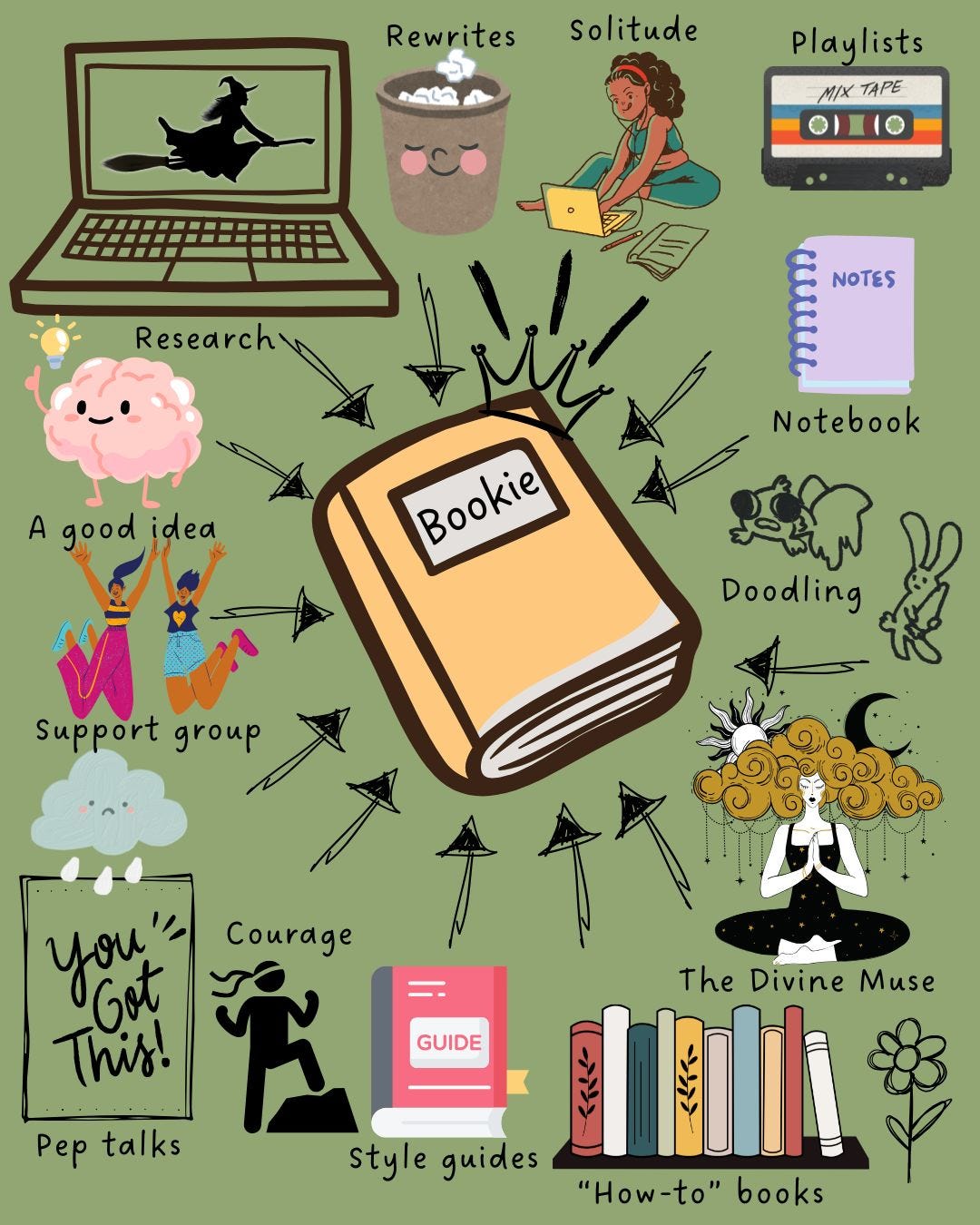
A good idea
I took an idea - not a great idea, just one relatively good one - and slapped it with a spectacular dose of hyperbole. I asked; what if? What would happen if a gutted poet, unaware of her supernatural heritage, accidentally cursed herself while writing a haiku? With this loosely imagined scenario, I trundled onto the page like a tipsy undergrad, making her way back to her dorm in the dark, without any outline or preconceived plot whatsoever. The story evolved into an amalgamation of personal experiences and a few of real souls, fused with overexaggerated circumstances and made-up outcomes. I often found myself in the position of a spectator watching the story unfold, and it was honestly, some of the most fun I’ve ever had.
Courage
After reading a little book called Why Will No-One Publish My Novel? by Fay Weldon, I realised I had to let go of the fear of being judged. I had to write honestly or my writing would lack substance and the reader would know. I had to expose myself in the same way that I do when I write poetry. If you want to be a writer, there is no other way.
Research
Witches are my jam. I knew quite a lot about wicca and paganism when I started writing Bloodbird, and what I didn’t know, I Googled. Most of my characters were moulded to the likeness of either myself, or people that I knew, and one male character in particular was shaped in the image of a celebrity on a Netflix show I was watching at the time of writing. The setting of my story is Gordon’s Bay in the Western Cape, my home for 25 years. I have an intimate understanding of the landscape and its seasons, and a profound sense of place here, so luckily, I didn’t have to do research to do the location justice.
How-to books
Could a writing degree make of me a better writer? Sure, it might. But I strongly believe that human beings are inherently creators. Creativity is in our DNA, no matter how left-brained you think you are. All we need is some guidance, or ideally, a mentor. I read a lot of books about the structure of stories, character and plot development, and how to make the reader give a shit about my hero’s journey. I highly recommend Harry Bingham’s books; Writer’s and Artists’ Yearbook Guide to How To Write and Writer’s and Artists’ Yearbook Guide to Getting Published. These are hard to come by these days. Try the your local library.
Style guides
In South Africa we use the British English as opposed to American English. I bought a copy of The Write Stuff by Dyken, Geldehuys and Viljoen-Smook (Pharos). I also love my Oxford Thesaurus.
Notebooks
I’m never without a cheap spiralbound notebook small enough to fit in my handbag. Our brains are way too bombarded with external stimulation and is just not capable of capturing our good ideas, especially when they (often) happen in the dead of night. I’ve gone through way too many of these to even guess the number.
Solitude
Writing a book was a lonely process, from the first to the last line, it was all just me by myself, committed to investing years on a project with zero promise of returns. I often wrote after hours or over weekends. I got frustrated when life’s responsibilities demanded my attention, when all I could think of was getting that chapter I’d been grinding away at for four weeks done. Sometimes even sleeping was a challenge. I’m a slave to my subconscious and will wake up during the witching hour of the night because of a desperate need to write down a note pertaining to dialogue between two arbitrary sub characters. Lots of alone time but once it was done, it was all worth it.
Playlists
Music helps a lot, especially instrumental music like Lo-fi, or music in a foreign language. Once I had my first draft down, I was able to listen to anything without getting distracted. I highly recommend creating playlists on Spotify. Find the playlist for Bloodbird here.
Rewrites
My first draft sucked. And so did the second one. Seasoned writers highly recommend taking long breaks in between rewrites and so this is what I did (often unintentional because life, motherhood, etc). For me writing well took a long time. English isn’t my first language. I used the free version of Pro Writing Aid during editing.
Doodling
Writing fiction can be fatiguing AF. I’m perfectly capable of spending four hours on editing one paragraph – no lies. I’m prone to engage in non-writing related creative activities to reset. I love art. I’m a huge doodler. Occasionally, I dare to dabble in watercolour and acrylics. I do this most days.
Pep talks
This one is probably the most important. Unlike non-fiction books, which can be acquired via proposal alone, a fiction writer has to bleed out at least 60,000 words without any guarantee that it will ever taste the sweet ink of a printing press. I had to believe in my ability to make something out of nothing that will either impress (literary fiction) or entertain (commercial fiction) or if I’m lucky, both. I check-in with myself often, and ask; Why do I write? What do I want share? I remind myself that I don’t have to impress every reader with my story. Storytellers are contributing architects of the human experience, but that doesn’t mean I have to try and write a book that changes the world. No reader of genre fiction truly thirsts for 300 pages of sanctimonious platitudes. Once I’d figured this out, I committed. Every rejection made me want it more. I remember saying to my husband one night after a rough week of Dear Author two-liner rejections, “Do these people not understand? I’m not going to go away until someone says yes.” I cheered for myself, and boy, I cheered hard.
Support group
I honestly don’t know if this is essential but my goodness it sure does help. I’ve been chasing this dream goal for a very long time. My husband, my family, and my friends have been cheering for me for many years, getting amped over every achievement with even more gusto than me, their delight exponentially increasing with every step I took. Cabernet Sauvignon was also an imperative part of my team. And that’s all I’ll be saying about that.
The Divine Muse of Creativity
You will not believe this until it’s happened to you. I was listening to a Joe Rogan podcast with Robert Rodriquez and he explained it exactly in the way that I’ve experienced it, and I’m relieved that I’m not as cray-cray as I thought I was. So, you’ve physically outlined or mentally conceived of your story to the best of your ability. You’ve created your characters down to last detail. You’ve concocted a flop proof plot vacant of any holes. At some point in your novel, you will lose control. Before you know it, your characters will start saying things you never meant for them to say. The story will develop in a way you never planned for and it will all become terribly embarrassing as you helplessly watch the shit hit the fan from the sideline. At some point The Divine Muse of Creativity will take over the writer will be rendered a mere vessel, and eventually the story will just write itself. I’m not making this up. There will come a time where I had to surrender and be channeled in this way. This also serves as a disclaimer for anything revolting that happens in Bloodbird. Jammer tannie, wassie ekkie.
TBC
In my next post I will be talking timeline, from conception to signing my contract with Marari Press. Also a few thoughts on query letters and my experience with local and international literary agents. I was committed to doing the latter during this newsletter but this one turned out quite lengthy.
If you’ve made it this far, thanks for reading. Kindly consider subscribing.
Next post will drop 1/7.
Bye for now.
Hi 👋 I enjoyed reading this.
Thank you for sharing.
I have always written for various reasons and seasons. I am finally neck-deep in the creative process. It's indescribable, really. Although I do occasionally journal what I can, when I can, I can sort of navigate through the unfolding adventure .
It is encouraging to connect with someone else's process , who is in the real-life circle of somebody I know in the apparently true version of the world.
I have a music list called " Divine Inspiration." I find it connects me through time , captures certain emotions, and enhances certain storylines floating in the play of my conscious/ subconscious .
Congratulations on bringing your creative work to life .
All the best with everything 🪶