Why I wrote a book
“There’s a little witch in all of us.” ― Aunt Jet, Practical Magic (1998)

A secret recipe
How to write a coming-of-rage tale about heartbreak, unlikely friendship, and the traumatic consequences of delayed trauma, but with magic.
You’ll need 1x medium sized cauldron cast iron potjie. Fill it with tears – when you eventually run out of sad ones, tears of joy will do just fine. Add one hefty pinch of Alice in Wonderland; a fair bit of Women Who Run with the Wolves by Clarissa Pinkola Estes; a few servings of Lana del Rey’s Born to Die – on repeat; a couple of cases of Cab Sav; and one broken Aquarian heart. Let it brood simmer over a low heat with intermittent bursts of hell fire, depending on the time of month. Occasional stirring recommended (stir counter clockwise during ovulation) for a period of no less than a decade. And that’s how to conjure a book like this. You’re welcome.
Okay. So, how did Bloodbird really come about? Seriously.
The year was 2012. As a newlywed, I was happy with life, and had made peace with a past version of me, the sad one who was stripped of colour, the one who was love-bombed into submission, and then dropped like a hot potato. Gone was the young woman once lost, confused, and quite frankly, dull and utterly boring. Why? Because along came a man who said, “thank God no one realised who you are.” – Jonathan Livingston, a direct quote. And the rest is history.
By then my studies towards a BA degree specialising in creative writing had, very sadly, come to a premature end. But I didn’t stop writing stories or poetry. I kept honing the craft – for years. I was busy working on the third draft of a different book - a YA speculative fiction novel about aliens, vampires and dragons - when I heard a song that ripped open an old wound.
The song
When Lana Del Rey’s Born to Die dropped, I thought it was the most euphoric song ever made. I went to bed with an earworm and was just about to fall asleep when I got yanked back to a dark time, post breakup with the other guy, where I believed I had no purpose, that I was unlovable, and that I wasn’t a good person. Someone without significance… merely born die. During those dark days, I was filled with perpetual dread and feared something unfortunate would befall me that would ultimately bring about my end.
This song took me right back to that place. I ached to let it out, to relinquish my demons and commit them to paper. And that’s exactly what I did. Similar to writing poetry, the process was like therapy.
That night, I got up and grabbed my laptop, jumped back into bed and wrote the first chapter of Bloodbird, a novel of magical realism that follows a poet who unknowingly curses herself by writing a haiku in a moment of unbearable grief.
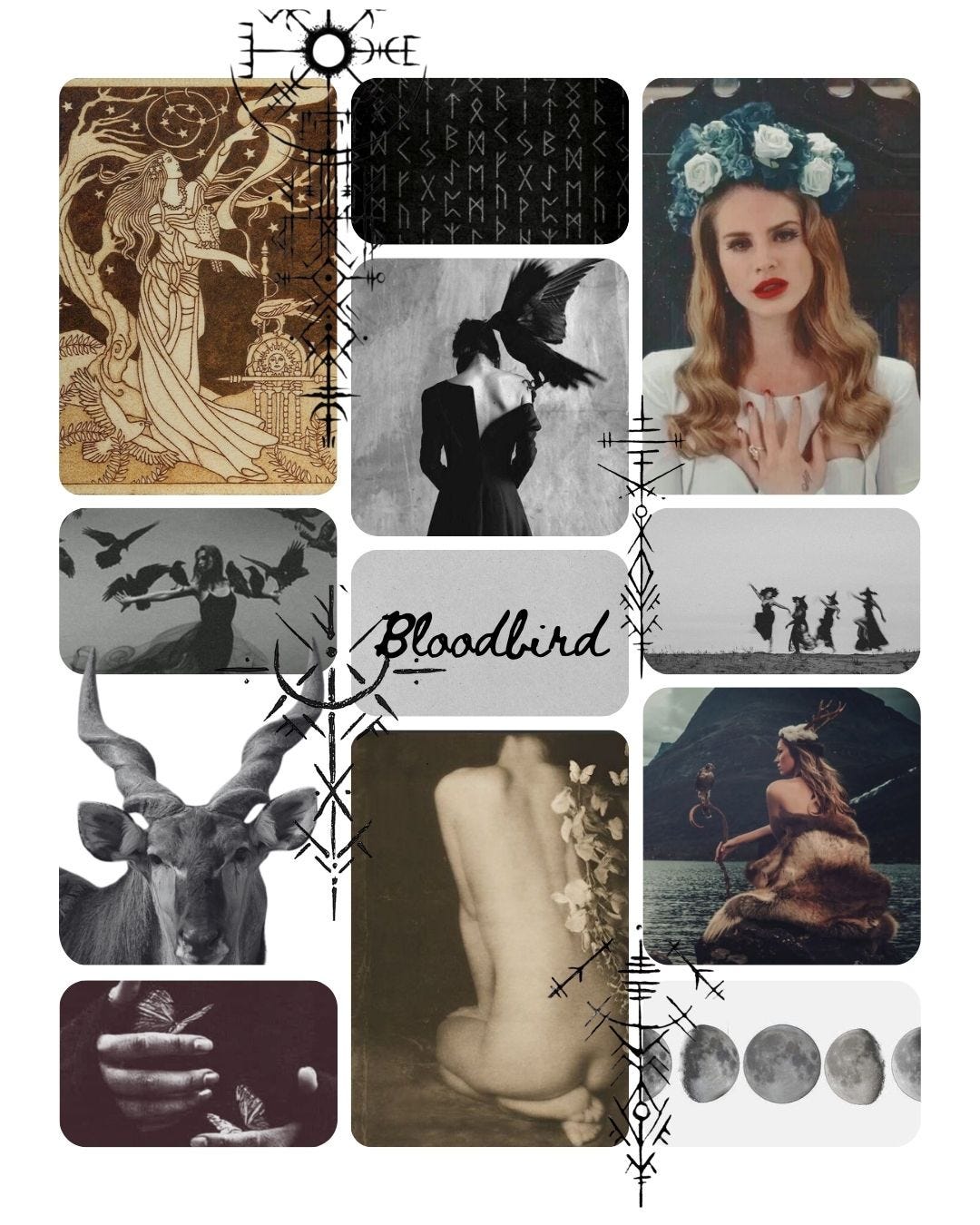
A project of autofiction
Autofiction is a literary genre that blurs the lines between autobiography and fiction. It often involves the author as a character in a narrative that is both based on their life and also contains elements of invention and fabrication. This genre allows for a more personal and subjective exploration of experiences, often delving into the complexities of memory, identity, and the relationship between the real and the imagined. – Google AI.
Like Naomi Sutton, I’d lived in denial for quite some time. I wrote a lot of poetry during these days. Leading up to my awaking, I suffered physical afflictions, much like my protagonist. Nosebleeds, sleep paralysis, and an overwhelming sense of impending doom became my every day. I’d even met my very own Ava Louw, not quite as troubled, but surely a bit lost, nineteen, tattooed and wilder than the wind: a much needed radiant burst of sunshine. We quickly became roommates. It was a crazy time for this thirty-one-year-old, to live with a teenager barely out of high school, and hang out with her friends - a large group of Somerset West rich kids. I would never have thought that this experience would one day bleed out onto the page and become my debut novel. And I’m glad for it.
What to expect next
I’m excited to share the process of writing Bloodbird. I will discuss the tools I used, and share the timeline from writing the first chapter to signing the publishing contract with Mirari Press (including all of the rejections by literary agents in between). Read about it in my next newsletter dropping 2/6. Kindly invite your creative writer friends to subscribe to my newsletter.
I leave you with these quotes:
“You were once wild here. Don’t let them tame you.”― Isadora Duncan, Isadora Speaks: Uncollected Writings and Speeches of Isadora Duncan
“Bone by bone, hair by hair, Wild Woman comes back. Through night dreams, through events half understood and half remembered...” ― Clarissa Pinkola Estés, Women Who Run with the Wolves
“Don’t write poems when you’re super sad. You might not know you’re a witch and accidentally curse yourself.” ― Naomi Sutton, poet, witch, and protagonist of Bloodbird.
It seems that I was led to you through a spell of some sort,
a warm whisper from a dear blood sister.
I am curious about your work as I am a lover of books, fantasy that merges into reality ( and vice versa).
I am a writer myself ( regularly mistaken for a witch) but have written rather privately for pure exploration of conscious play.
I find writing in itself to be a sort of magic that connects one to self and also the whole of existence.
I am busy with a piece that lights up my soul and this one I aim to publish. Who knows , maybe one day it shall find you too.
Your work sounds captivating . Thank you for sharing.
Aquarian, Lana del Rey, witches... are we ... the same person?!